
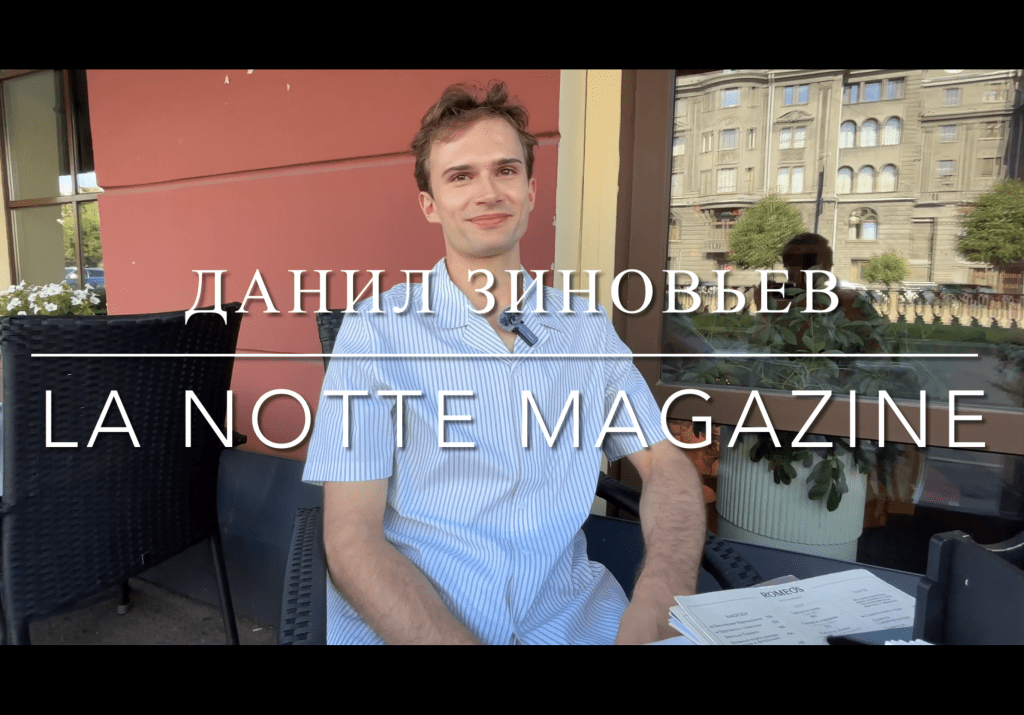
We met with Danil Zinovyev, a dancer with the Mariinsky Ballet, and discussed his participation in the International Ballet Competition in Moscow, working with Alexander Sergeev, and his professional views and interests offstage. A Russian-language version of our conversation is available on video.
Danil, congratulations on your outstanding participation in the competition!
Thank you.
How do you feel now?
I have very different feelings, especially now, a week after the competition. Finally, I think everything has settled down, all these emotions. I can say that right after the competition I actually felt nothing.
It felt like everything suddenly became quiet. After such a week, when every day you think about the competition, about what you need to do, about the nerves… Right after the competition, when everything was over, there was just silence. It was the first time, I think, in these several months when I simply had silence.
Then, the next day and a week later, I started to feel everything that I probably wanted to feel. Now I am in some kind of state of euphoria. I am just very happy that I was able to participate in such a competition.
I always dreamed of taking part in this particular competition. So it felt like I could finally put a check mark: yes, I participated in it. And not just participated, but reached the third round.
It seemed to me that this competition was, first of all, a challenge for myself. Can I handle it? Can I go through all of this? Before the competition, I was really a little afraid: what if I cannot cope, what if I cannot show six classical variations and contemporary choreography?
For me, it seemed like a very serious challenge. I even had thoughts: what if I do not reach the third round at all?
After this week, I realized that I was able to test my own endurance. How much can I make myself work? What can I actually do with my body in this art? So, yes, for me it was a big challenge.
Have you participated in competitions before?
Yes. From the age of eight until fourteen, I participated in YAGP (Youth America Grand Prix) every year. This competition takes place all over the world. Back then, and now as well, there were semi-finals in different cities, and then all participants gathered in New York for the final at the end of the school year.
Every year I had the semi-final in Seattle, and then the final in New York. It continued this way from the age of eight to fourteen.
So, you could say that you are already an experienced competition participant, even though there was a long break?
Yes, after a very long break. Of course, I had not had this kind of experience for a long time, so it was a little bit of a shock. But honestly, I would say that this was my first truly major competition experience as an adult.
Because it is impossible to compare the Moscow Competition and YAGP. There, you performed once in your city, and then one more time in New York. But here, you go on stage at the Bolshoi Theatre every day for an entire week. It is absolutely impossible to compare.
Who did you prepare for the competition with? And how did you choose the repertoire?
I was preparing with Maxim Zyuzin, a soloist of the Mariinsky Theatre. But unfortunately, we did not choose the repertoire together.
It happened that I did not have a teacher who could prepare me specifically for the competition. And when I made the decision to participate quite late, I had to choose the repertoire myself.
It was not easy. But fortunately, my parents are also ballet artists. They were leading dancers in Krasnodar and worked with Yuri Grigorovich, so I was able to discuss the competition and the repertoire with them. They helped me a lot. Besides that, I was able to discuss the repertoire with Andrian Fadeev. In the end, all together, we gradually created the competition program.
After some time, I approached Maxim Zyuzin and asked if he could prepare me for the competition. He agreed, and from that moment we worked every day. It was a very valuable experience. I am very happy that I was able to work with him. He helped me enormously, and honestly, I would not have wanted to prepare for this competition with anyone else.
Actually, I think that the fact that you chose the repertoire almost independently allowed you to show much more of your own personality and character in the competition.
Yes, I think everything really came from me. I chose exactly what I felt could show me best on stage.
Speaking about “The Organ Grinder” by Alexander Sergeev. How did your collaboration come together and how was this, I would say, very poetic work created?
When I decided to participate in the competition, the first thing I started thinking about was the repertoire and who would create the contemporary piece. To be honest, I decided on the contemporary choreography right away. I thought about the classical variations for a very long time, but with the contemporary piece I immediately understood that I wanted to work with Alexander Sergeev.
I had already worked with him in Coppélia and in Concert Dances, and I really liked the process itself. I liked how he works with music, how he explains movement, how he works in general.
I really like that he always looks for an approach specifically to the artist. Sometimes he explains a movement in one way, sometimes in a completely different way, just so that the artist understands what he wants to achieve. And it really works. He finds different ways to explain the task, and you immediately understand what is required from you. It was really great.
That is why I knew right away that I wanted to work with him.
I approached him, and he agreed, which made me very happy. He immediately said that he already had an idea. Actually, he originally wanted to create this piece for himself, but he said that he would be very happy to set it on me.
Sasha works in such a way that he comes to rehearsal with almost finished choreography. So we created the whole piece literally in just a few rehearsals.
But he did not know what kind of ending he wanted. He said that he did not know yet what it should be. He wanted first to see how I would perform the rest of the piece, how the movement would look specifically on my body, with my own movement, how I would experience this material.
Then we started looking for the ending together. He suggested different options, watched how I performed them, asked what I liked. And gradually we finished the piece this way. I immediately loved this choreography. I really liked how it exists together with the music.
Overall, the whole process was wonderful. I am very happy that I worked with him. I really want to continue collaborating with him and, of course, I hope to dance “The Organ Grinder” many more times. We have already discussed with Alexander that we would really like to show it somewhere else on stage.
What does “The Organ Grinder” mean personally to you? And how did you look for this image?
I thought about it a lot. A difficult question… Although not exactly difficult.
In general, this part of the opera is very sad. At its core, it is the story of a person who plays his music, but nobody needs him. Nobody wants to pay attention to him, nobody wants to help him. Everyone passes by, as if asking: “Why is he even here?”
It is a very sad story. Of course, I do not want to directly compare myself with this organ grinder. But during the preparation for the competition, I had the feeling that I went through most of this journey on my own. Sometimes I felt lonely.
Probably, that is why these two stories connected a little inside me. At certain moments, I really felt similar to this character. Although, of course, I do not want to draw direct parallels. My life was not nearly as tragic. It is just that some feelings were similar. In general, “The Organ Grinder” also became an opportunity for me to rediscover contemporary choreography. I had not had this kind of experience for a long time.
After the John Cranko School and Stuttgart, I had a lot of contemporary repertoire, and I really missed this feeling. Maybe it was some kind of liberation. I felt again how it is possible to exist in this kind of material, how it is possible to dance like this. It was really wonderful. As for the image itself, I think I did not really have to look for it.
When I first heard this music, it immediately put me into the right state. And then the same thing happened at every rehearsal. I kept returning again and again to this feeling, of sadness and inner suffering. I think it is impossible to dance differently to this music. The music itself immediately gave me this image.
I feel that in this piece, visually, in the movement, and in the way it exists in relation to gravity, there is something from the world of Marc Chagall. Although Chagall is more often associated with Paris, here you can still feel a kind of Europe at the crossroads of eras. Maybe even the same decades, but a hundred years ago.
Yes… probably. There is something like that.
How do you see your type as a dancer today? There is a feeling that dramatic roles are especially close to you. Do you agree with that?
Yes. Probably for the first time I thought about it after I danced the role of the Gaul in Spartacus. He appears on stage literally for about thirty seconds. During those thirty seconds, he fights for his life, he does not want to die, and then he is the first of the three to be killed. And I really liked playing this role. As strange as it may sound, I really liked dying on stage.
It was my first experience when I truly had to show such a state. Later, people came up to me and said: “You played it really well.” And then I realized how much I enjoy existing in such dramatic roles.
But in general, I do not want to put myself only into one category and say that I am exclusively a dramatic or tragic dancer. For now, it seems to me that such roles are really close to me. Perhaps I feel them. But I do not want to limit myself. I want to have the opportunity to dance everything, or at least try.
If you had asked me this question several years ago, I would have answered without hesitation: “Only princes.” I thought that was my only type.
But over time I realized that I do not want to put myself into such limits.
I would like to dance, for example, Basilio in Don Quixote or the Torero in Carmen Suite at least once. These are completely contrasting roles compared to princes, but I think that exactly such roles help a dancer grow.
So I do not want to limit myself to one type. I want to try everything.
Is there a role that you already feel inside that you are ready to dance, but you have not yet had the opportunity to perform?
There are many things I would like to dance. But the question is whether I am ready right now? I think you can never say that you are completely ready for a role.
I think that if I were given any ballet and the opportunity to prepare it, I would do everything possible to complete this work as well as I could.
Everything just needs time. Sometimes people ask: “When will you be ready to take the next step in life?” But I think nobody is ever completely ready.
There is no such moment when suddenly you understand: that is it, now I can. You simply have to take this step. You have to go through all the difficulties, and only then do you truly become ready.
So it is difficult for me to name one particular role. Of course, there are roles that feel closer. If I still have to name one… Probably Albert in Giselle.
Out of all the classical ballets, this one feels especially close to me. I have watched recordings of different performances so many times… And I have cried so many times after the first act scene. So, probably, it is Giselle.
Who inspires you in your profession? Are there any artists you especially follow?
Many people inspire me.
If we talk about the past, in Stuttgart I was incredibly inspired by Friedemann Vogel. I think he has a completely unique quality of movement. He exists in movement so organically, so naturally, that I have never seen anything like it from anyone else. Everything looks very plastic, calm, and confident. When I was still working in Stuttgart, I literally watched him every day.
I looked at him with huge eyes, analyzed absolutely everything he did. I tried to attend almost every one of his performances because I wanted to understand how he does it.
I wanted to live through every role together with him, to understand how he goes through all these emotions, why at that exact moment he makes that particular decision, why he exists in the role in that specific way. I wanted to know everything and learn. He inspired me very much.
And now my colleagues inspire me. Working at the Mariinsky Theatre is a dream. For me, it is a great honor to be with them in the same studio. It inspires me every day.
And, of course, my parents. They taught me everything I know in this profession. Every day I remember everything they taught me, all the foundation they gave me. They always worry about me, always ask how things are going. Sometimes I send them recordings of my performances, and they comment on something, correct something, give advice. They also inspire me very much.
You studied at the John Cranko School and then worked in Stuttgart. What did this school teach you above all? And what from this experience do you still feel today while working at the Mariinsky Theatre?
I think that, first of all, the school taught me to be a versatile artist.
In general, the repertoire in Stuttgart is very neoclassical and contemporary. It was the same at the school. We constantly danced classical ballet, contemporary dance, and neoclassical works. The repertoire was always very diverse.
Besides that, Stuttgart itself, both the theatre and the school, is a very international environment, a kind of “soup”. There were French, Germans, artists from many different countries. The great teacher Peter Pestov taught there. It became a completely unique place where you simply had to be a versatile dancer. There was no other way.
Probably, that is exactly what I brought with me to the theatre. When I look at a role, I always think: can I do this a little differently? Is there another possibility? We were taught to look for different solutions.
I do not think that Russian schools do not teach this. It is more that I simply perceive this process differently.
Actually, it is very interesting because it turns out that European and Russian schools came together in your development. It seems that this combination creates a very interesting result.
Yes, maybe.
Now, a little about you outside the stage. What is something about Danil Zinovyev that almost nobody knows? What do you like to do when you do not have rehearsals and performances?
I really like architecture and interior design.
In general, everything connected with this. If I had not become a ballet dancer, I would probably have become an architect or an interior designer.
When I was around eight or twelve years old, I constantly watched documentaries about how towers and other buildings were constructed. I was always interested in both old architecture and modern architecture. Architecture in general.
I really like when there is an idea behind a building. When it is not just some kind of cube, but there is a thought behind the architecture.
Maybe it is a reference to the old architecture of the city. Or a modern building is created using materials that are historically characteristic of that particular place. I find this incredibly interesting.
Sometimes I just walk around the city, whether it is St. Petersburg or any other city, and look at buildings. Honestly, I can do this all day.
Do you have any favorite architectural styles?
I cannot say. I like absolutely everything.
Although earlier I would have answered that I did not really like Bauhaus. But now I have also started to see beauty in it. For example, when I was in Berlin, I saw many beautiful buildings in this style.
So now I cannot choose just one. I think every architectural style is unique in its own way. Each one creates different emotions and allows you to perceive it differently. So no, I cannot choose one.
What qualities do you value most in people? Both in the profession and in life?
I think that both on stage and outside of it, it is probably authenticity. Because in the modern world, in social media, sometimes the real person gets lost.
Often people start showing what they think will get more likes or attract more attention.
Sometimes, as it seems to me, this also appears on stage. Not in the sense of likes, of course, but when you watch someone performing a role and understand that the artist does not feel it. The audience feels it too. When a dancer does not truly live through the role, does not put their emotions into it, it becomes a little sad.
Because you want to feel it together with them. Everyone comes to the theatre for different reasons, but personally, I go there for emotions.
I like crying in the theatre. Not necessarily because something tragic is happening. Sometimes something so beautiful happens on stage that it also brings tears. Something that truly touches you.
So I would say that the most important thing is to be real.
Can we say that the stage becomes a place for you where you can express things that are much more difficult to express with words?
Yes, I agree with that. Probably one hundred percent.
Even if we remember the same Gaul in Spartacus, in ordinary life there is nowhere I could experience such feelings. But the stage gives me this opportunity.
Thank you for this conversation, for your sincere attitude to life and profession, and for the opportunity to see not only the artist, but also a person who thinks deeply and analyzes. I wish you good luck with finishing the season and, of course, in the next one, new achievements and new roles.
Thank you very much.
Interview: Julia Sumzina
 LA NOTTE MAGAZINE
Leave a comment